A Visual Update
Here are some pictures from around the garden, taken in the past few weeks.
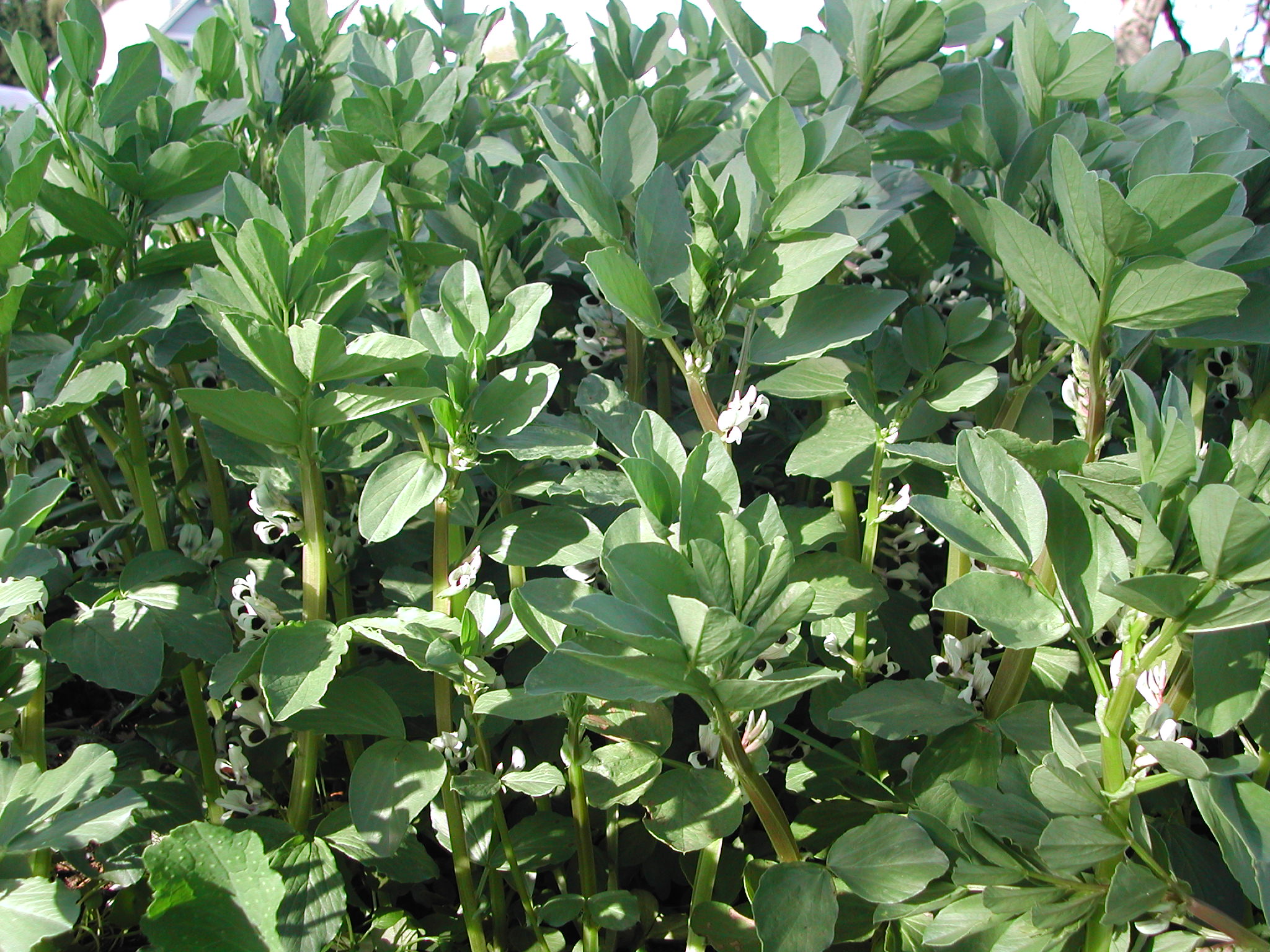
Fava beans in bloom

Sugarsnax carrots I thinned this week; making good progress

Scallions/green onions in the hoop house, along with the nicely progressing carrots
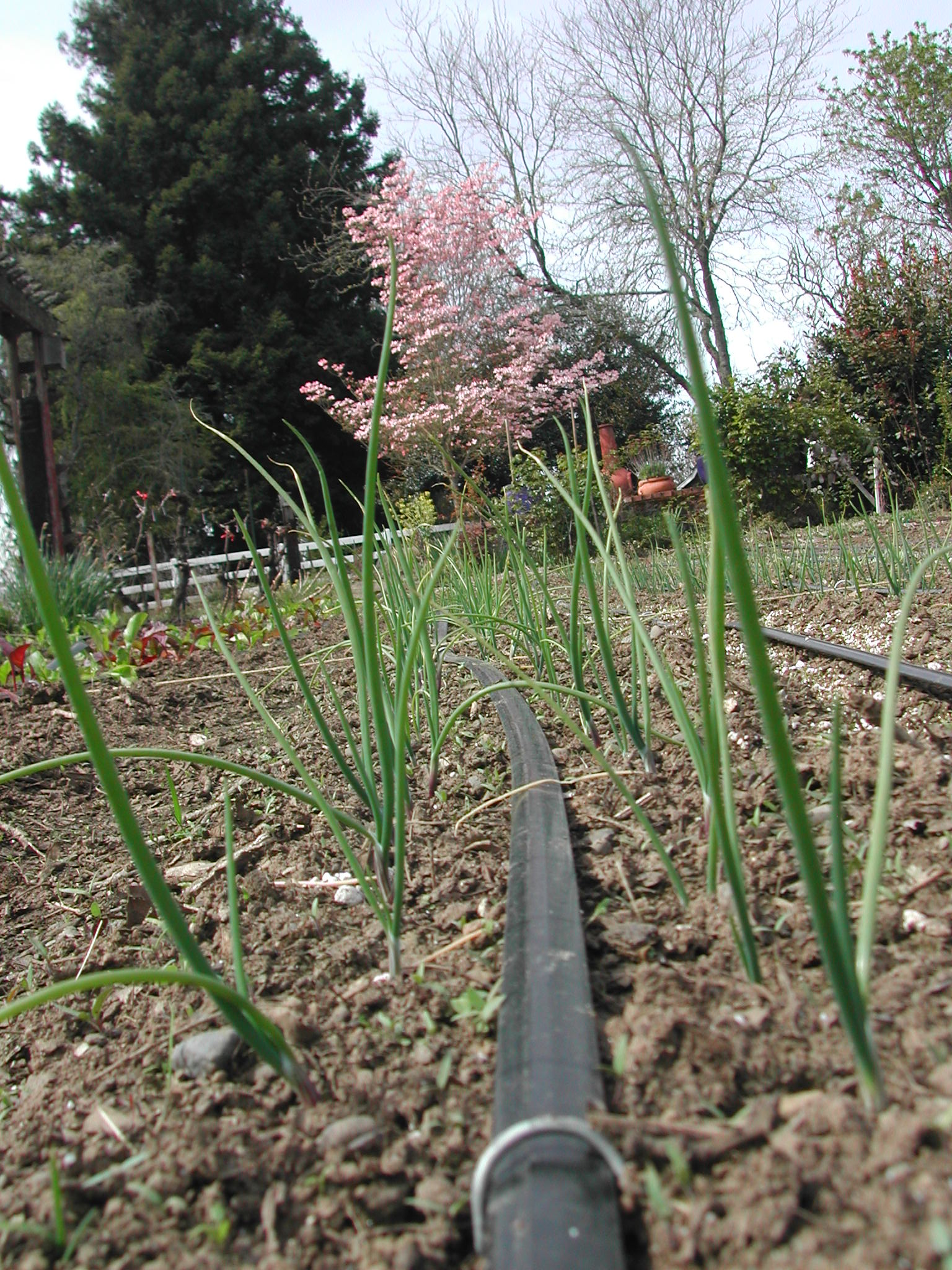
Onions in the ground

Beets ready to thin
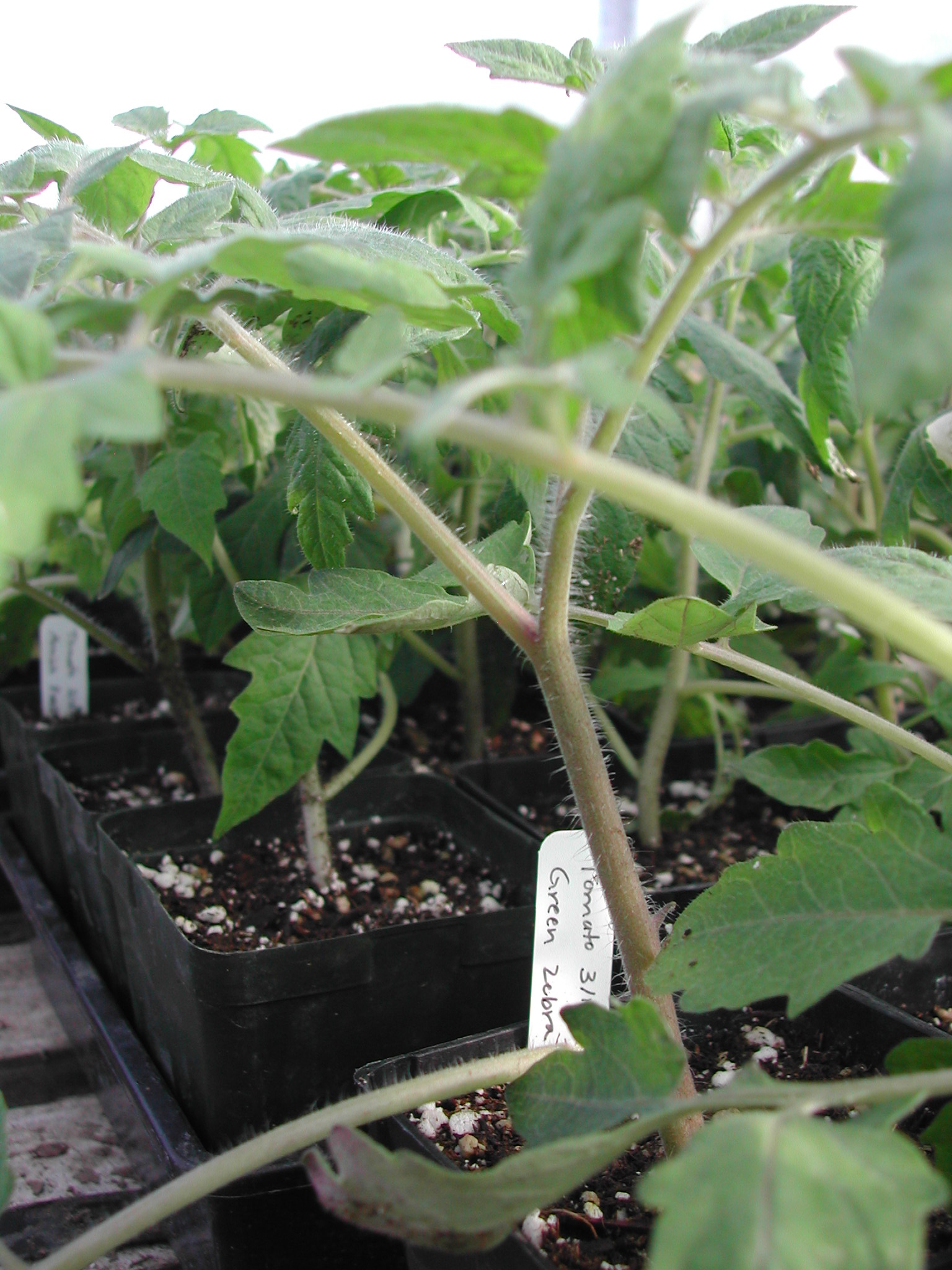
Potting up tomatoes and moving them out to the hoop house
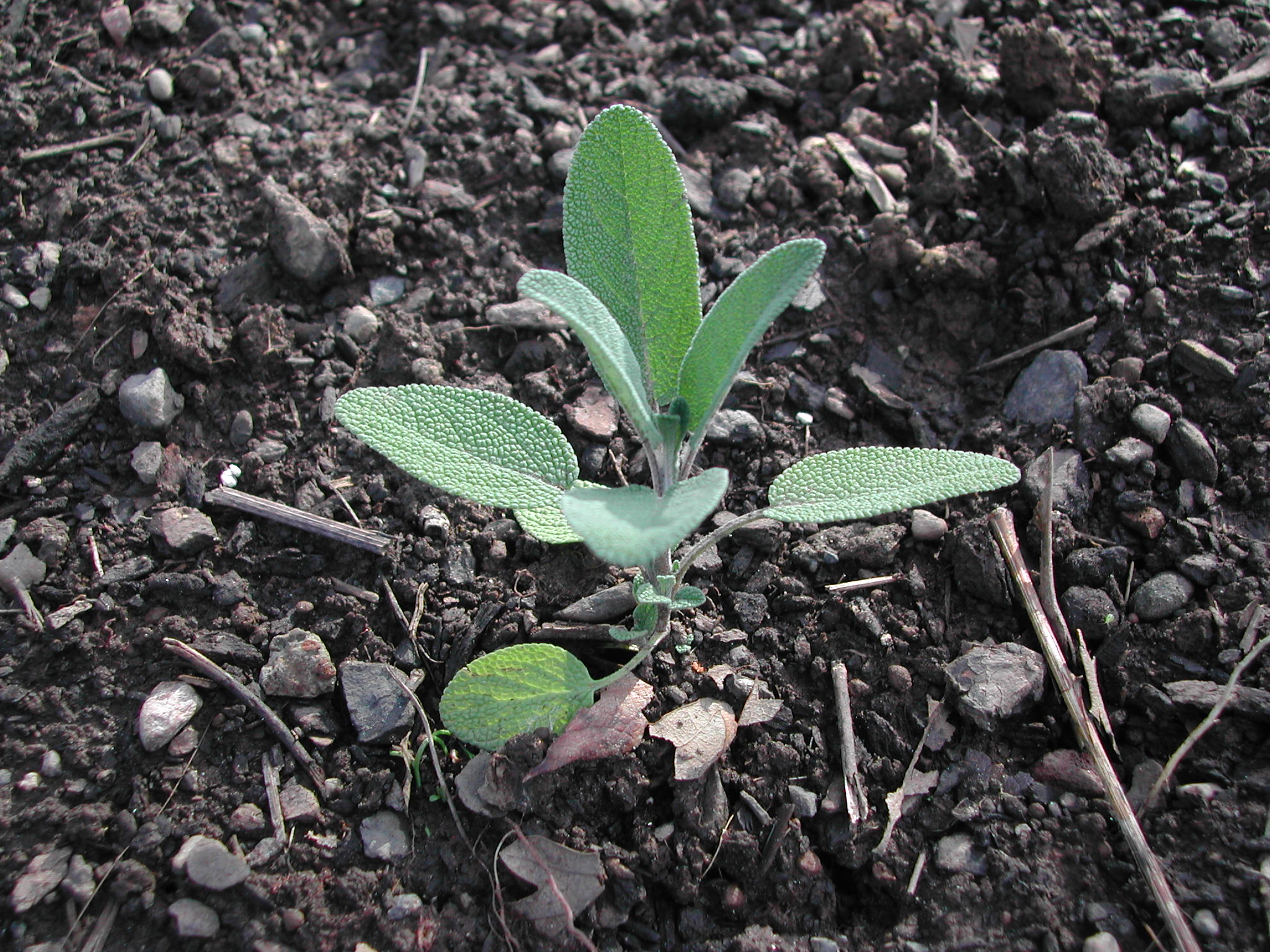
Maybe some sage this year?

Asian pears about ready to thin
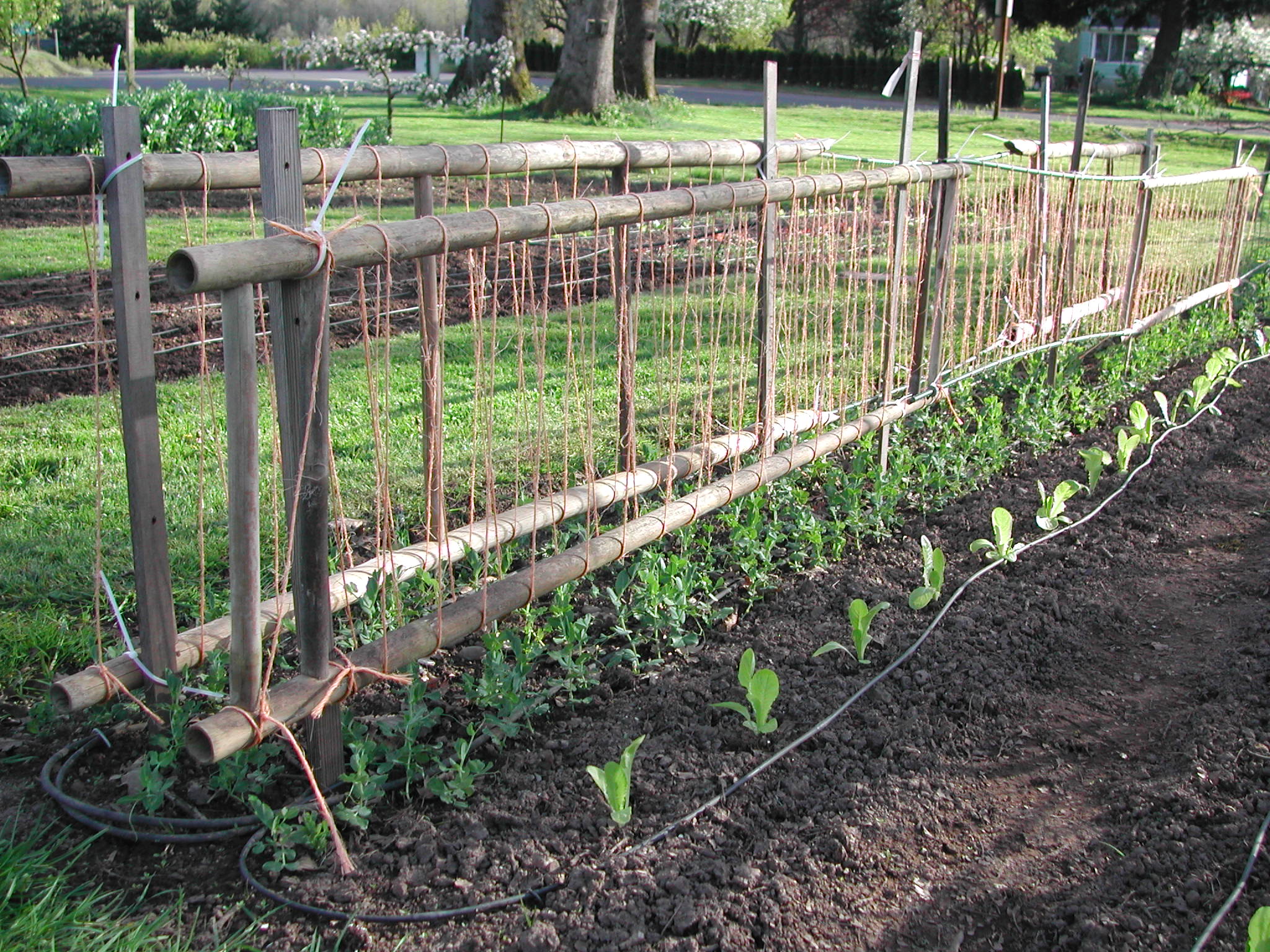
Using what we have for pea trellising
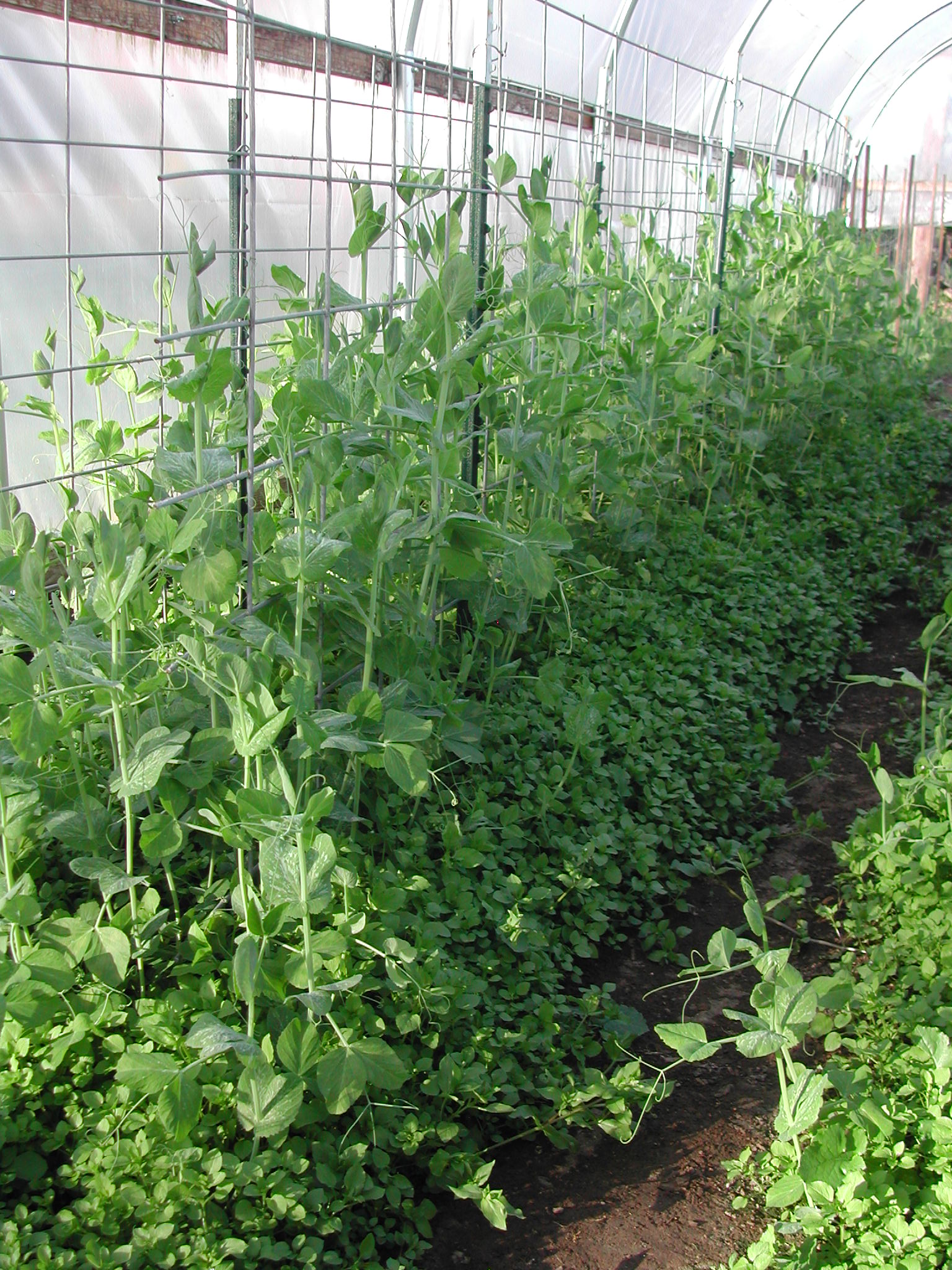
Peas in the hoop house, before weeding
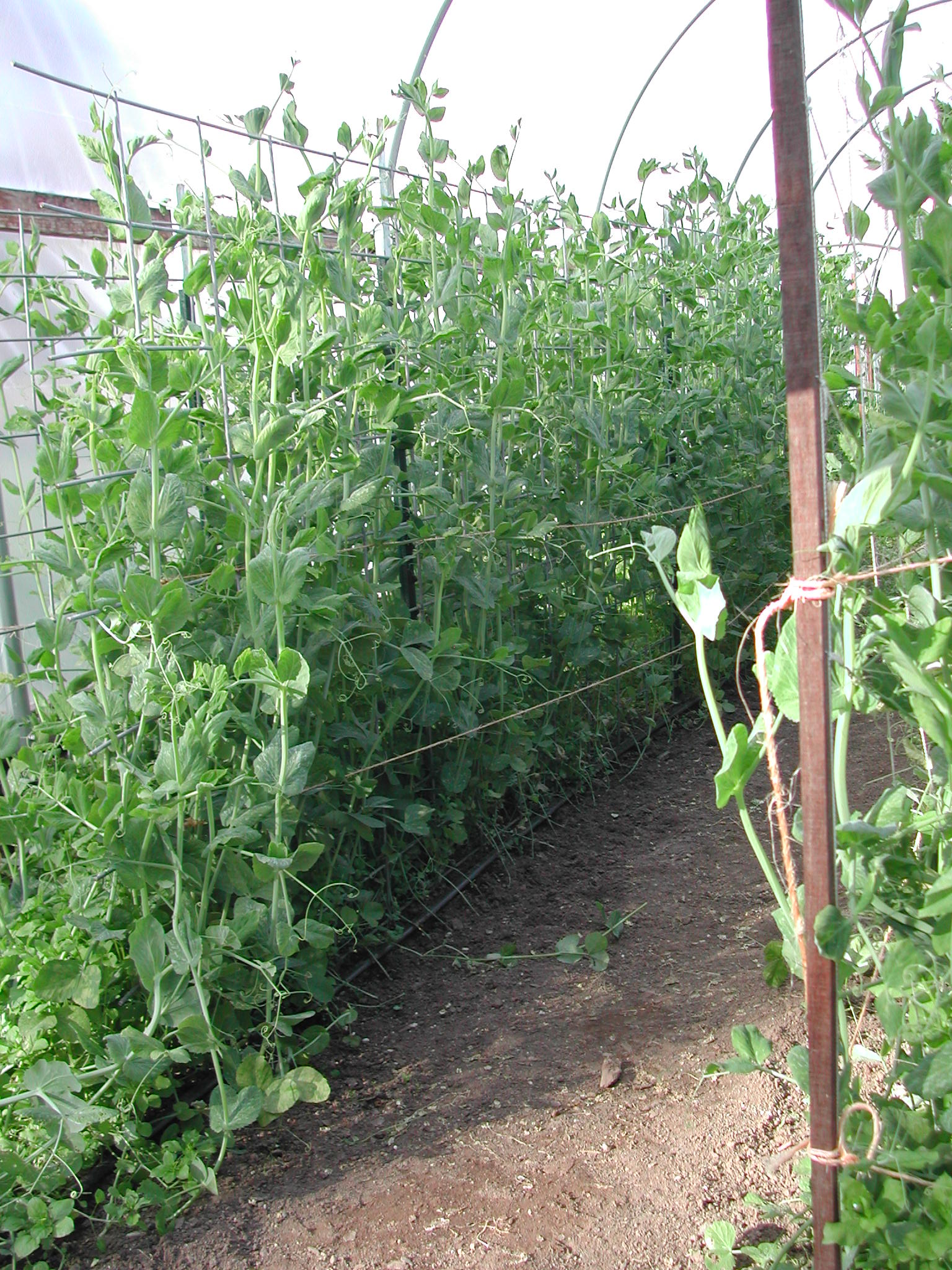
Peas in the hoop house, after weeding (still a little more to go)
Farmer or Pet Owner?
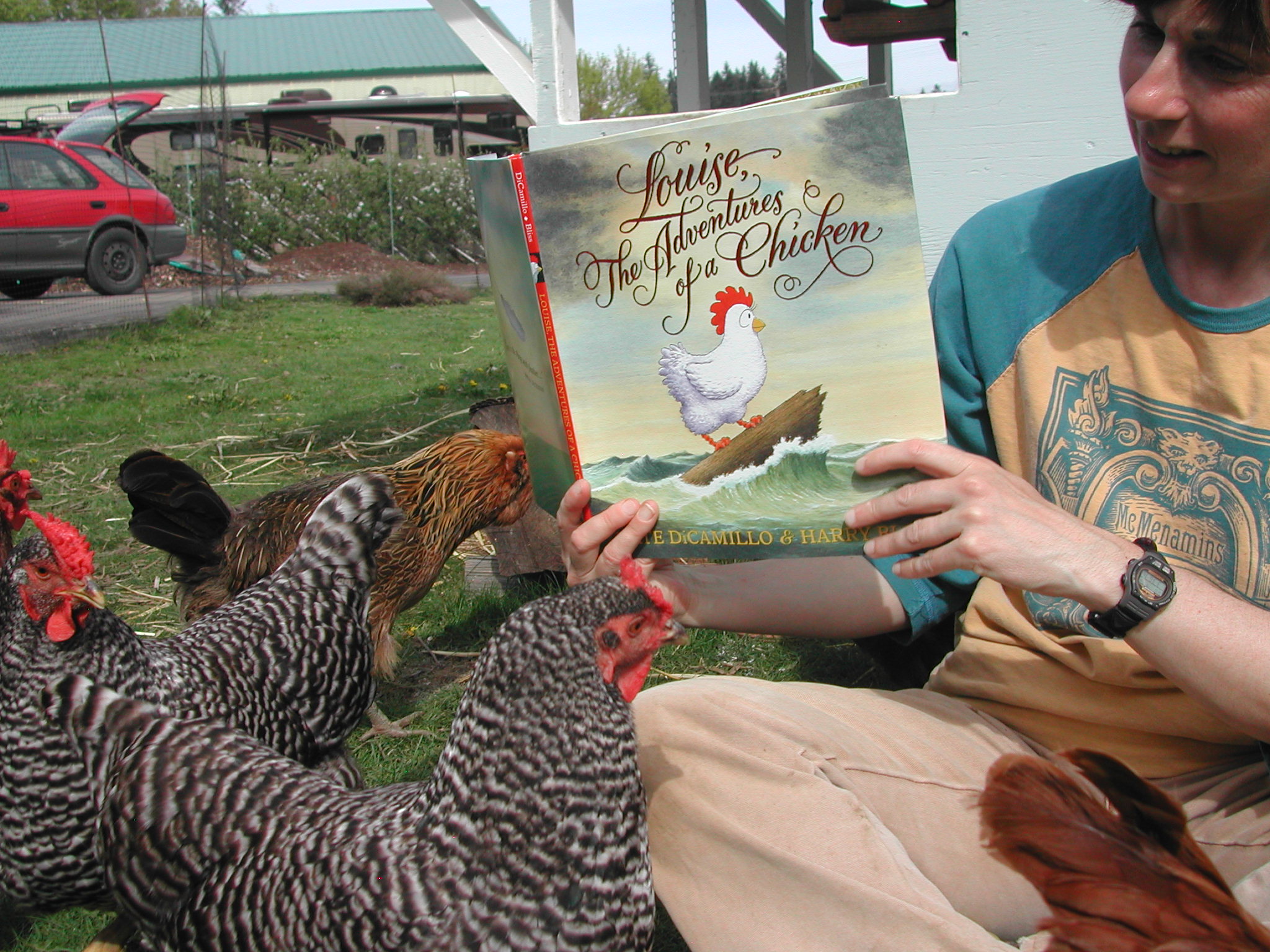
I'm still a librarian at heart: story time for the girls
In the last post, I mentioned I was taking a class at Gales Meadow Farm, hoping to learn how to scale up my production and work more like a farmer than a gardener. While this class may help me be more like a farmer in terms of growing plants, I discovered animals are another matter.
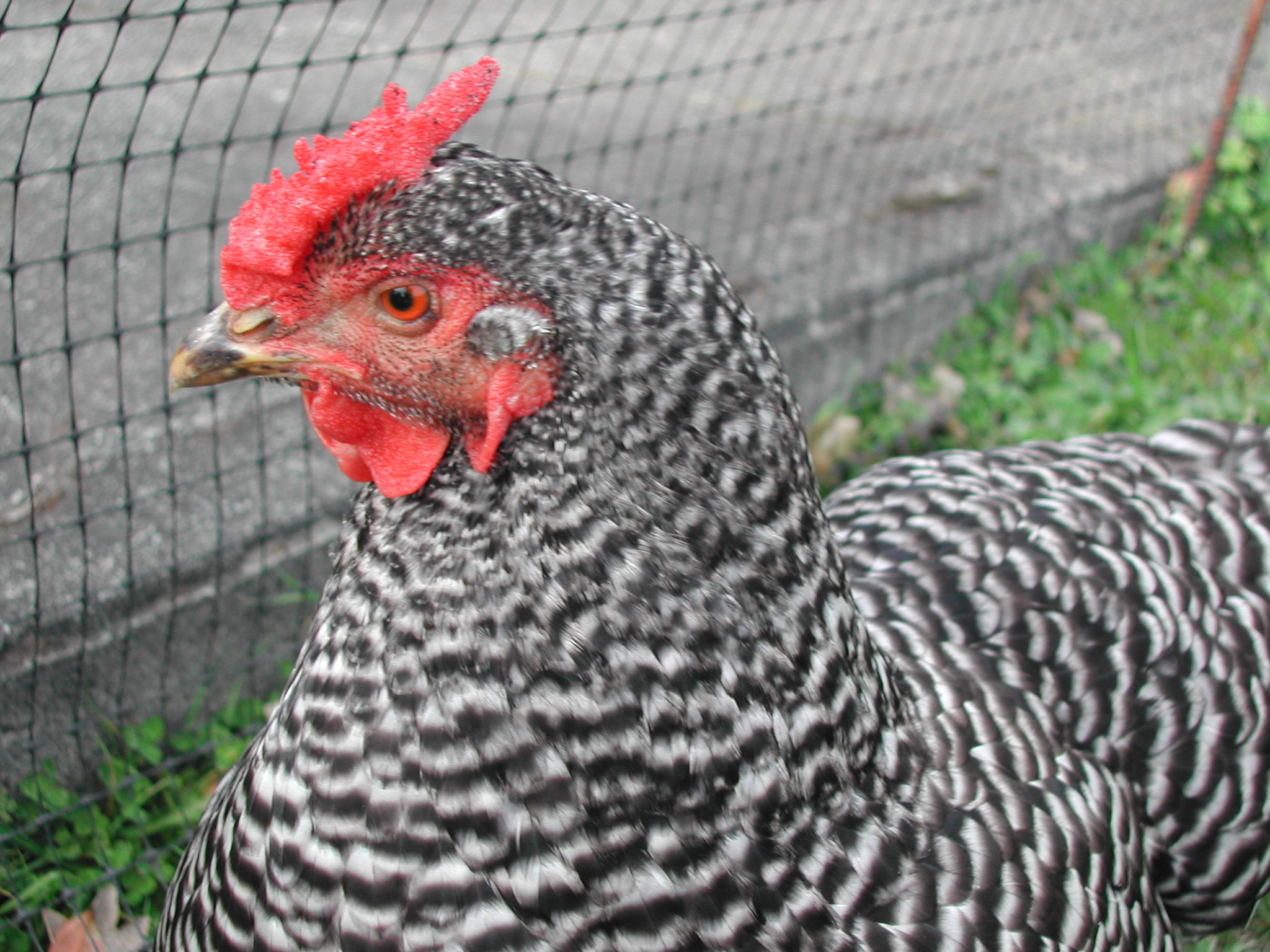
One of the Dominiques
Two years ago we bought some chickens. We had a definite purpose in mind: the chickens were to be workers, eating the bugs in the apple orchard and vegetable beds, and providing fertilizer. We considered the eggs an added bonus. People often asked us, what will you do with them when they stop laying eggs? At first I thought, maybe they will be stewing hens. It didn’t take long before I realized that would never happen. Not only would I never be able to kill these girls, but I wouldn’t give them to someone else to kill, because I wouldn’t eat them, either. So I reminded people why we got them, that they will keep doing their jobs long after they stop laying.
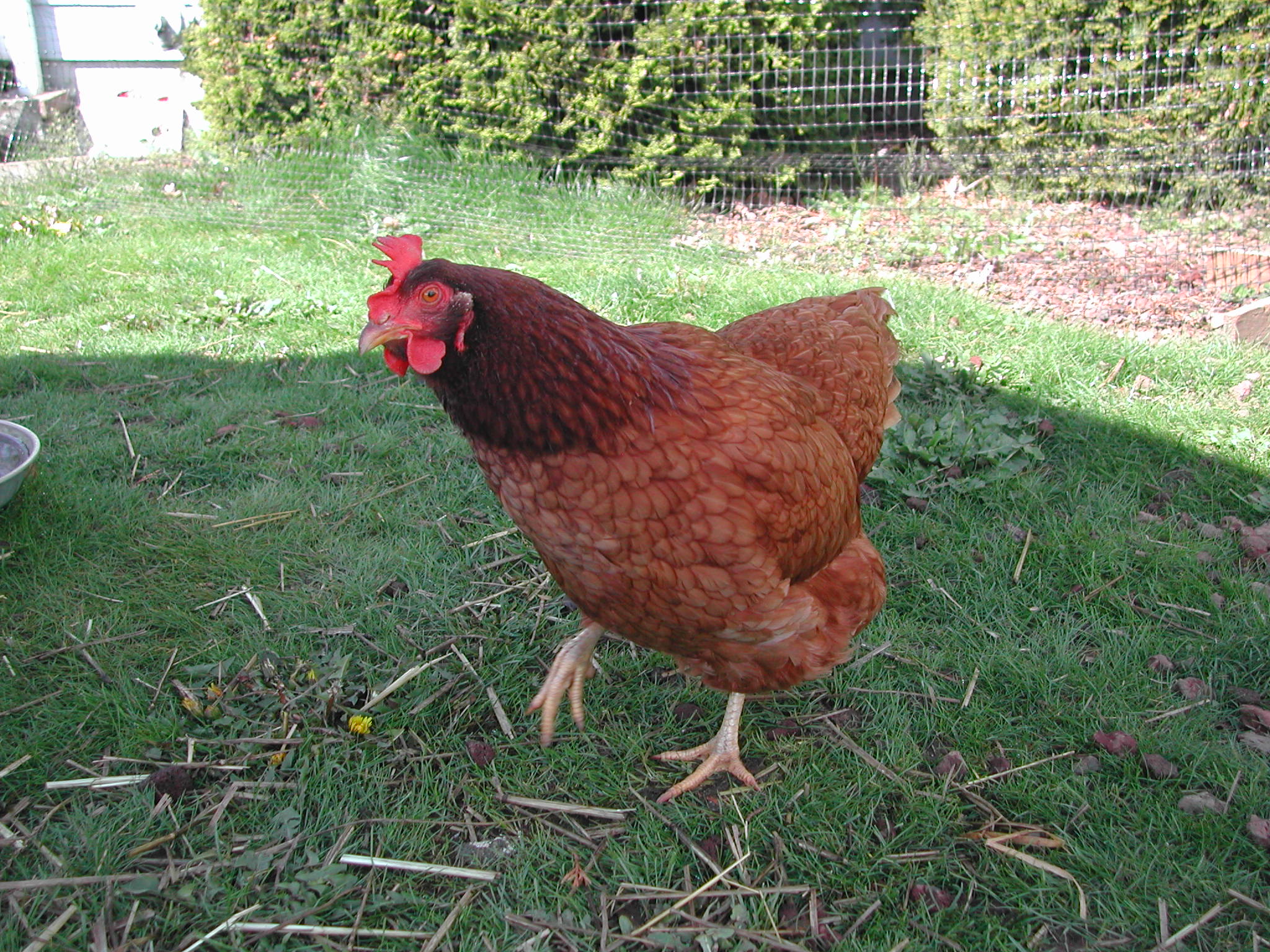
The Rhode Island Red that was not well
Last fall, one of our Rhode Island Reds wasn’t doing well. She was slow, lethargic, she slept a lot, she stood with a different posture and kept to herself. I thought maybe it had to do with her molting, and eventually she seemed to pick back up. But it happened again in March and she kept getting worse. I looked on the internet for what her symptoms might mean: egg bound? sour or compacted crop? I asked at Naomi’s Organic Farm Supply when I was there picking up some fertilizer. They had some ideas and gave me the card of a avian specialist vet in Lake Oswego.
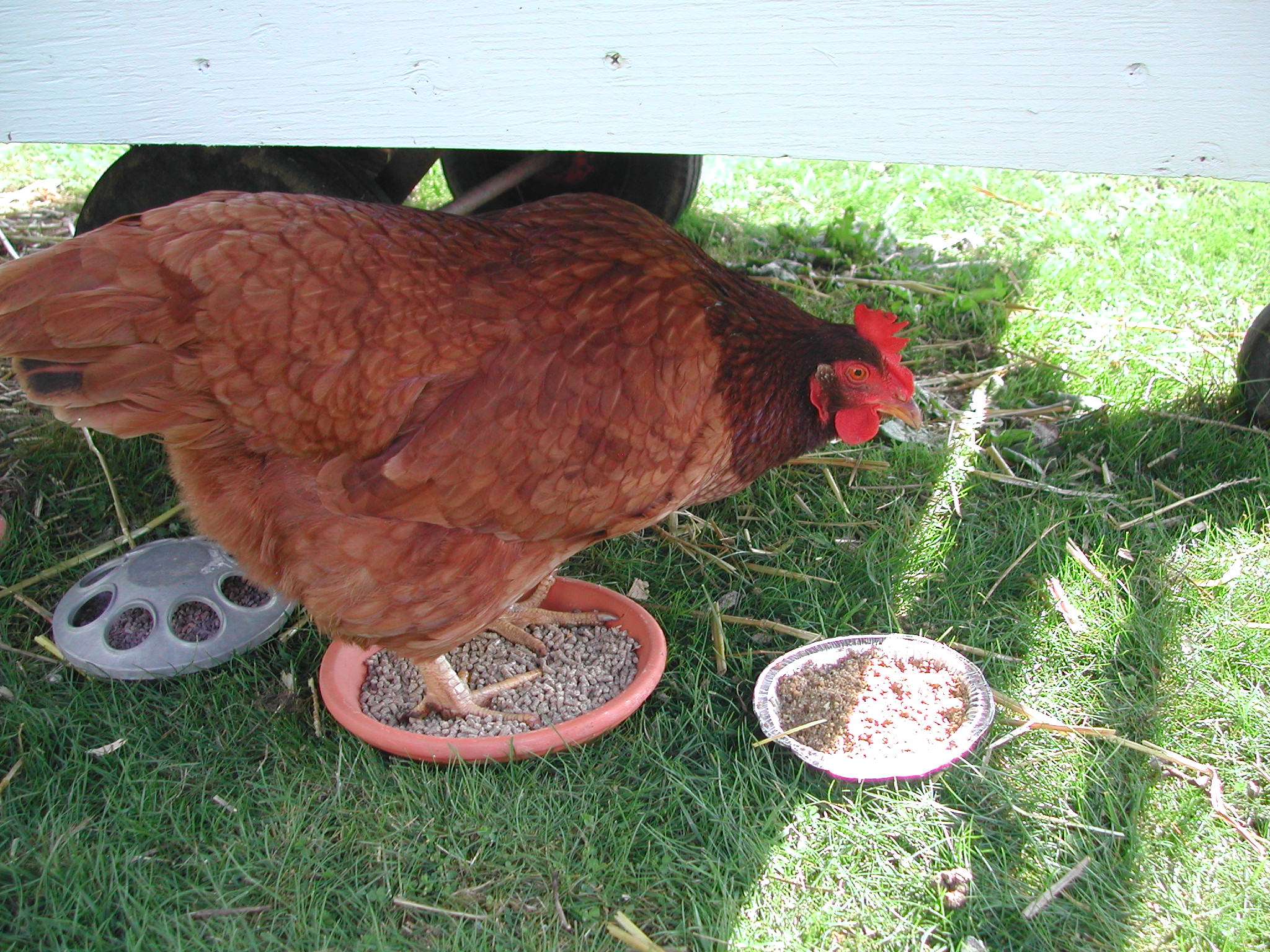
Here she is again, now known as "The Sick Girl"
I tried a few solutions for things that could be wrong, but nothing seemed to work. I had to decide: was I going to be a real farmer and cull her from the flock or a pet owner and take her to the vet? It became official: I was a pet-owner. I took her in a found out she had injured her liver, bled into her abdomen and built up fluid there. They took fluid out of her abdomen and gave me antibiotics for her. She picked up for the first week, but the next week it was worse again. What should I do? How much money do you spend on a chicken? One without a name? One that no self-respecting farmer would take to the vet? I took her to Lake Oswego again. More fluid was taken out (a record amount, the vet said) and I got more antibiotics for her. That was two weeks ago. Last weekend, we thought we were going to loose her, she was doing so poorly. To our surprise, she perked up last Monday and seemed to get better all week.
This week, I am still not sure she will make it. I told myself at the last visit that this was it. I’d have to let her go if she didn’t get better. Oh, if only I were a farmer…
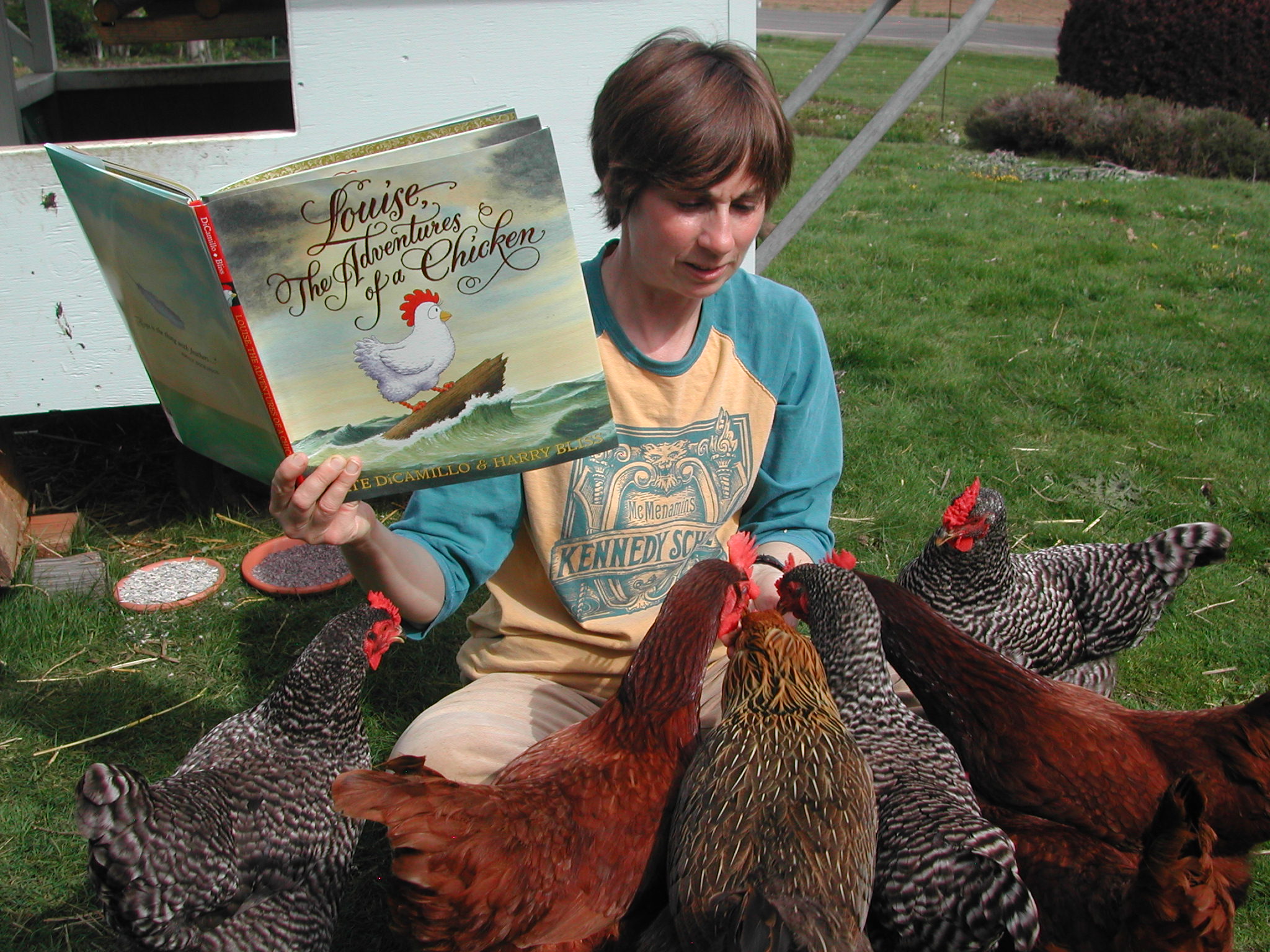
Story time takes a lot of scratch
Spring Showers
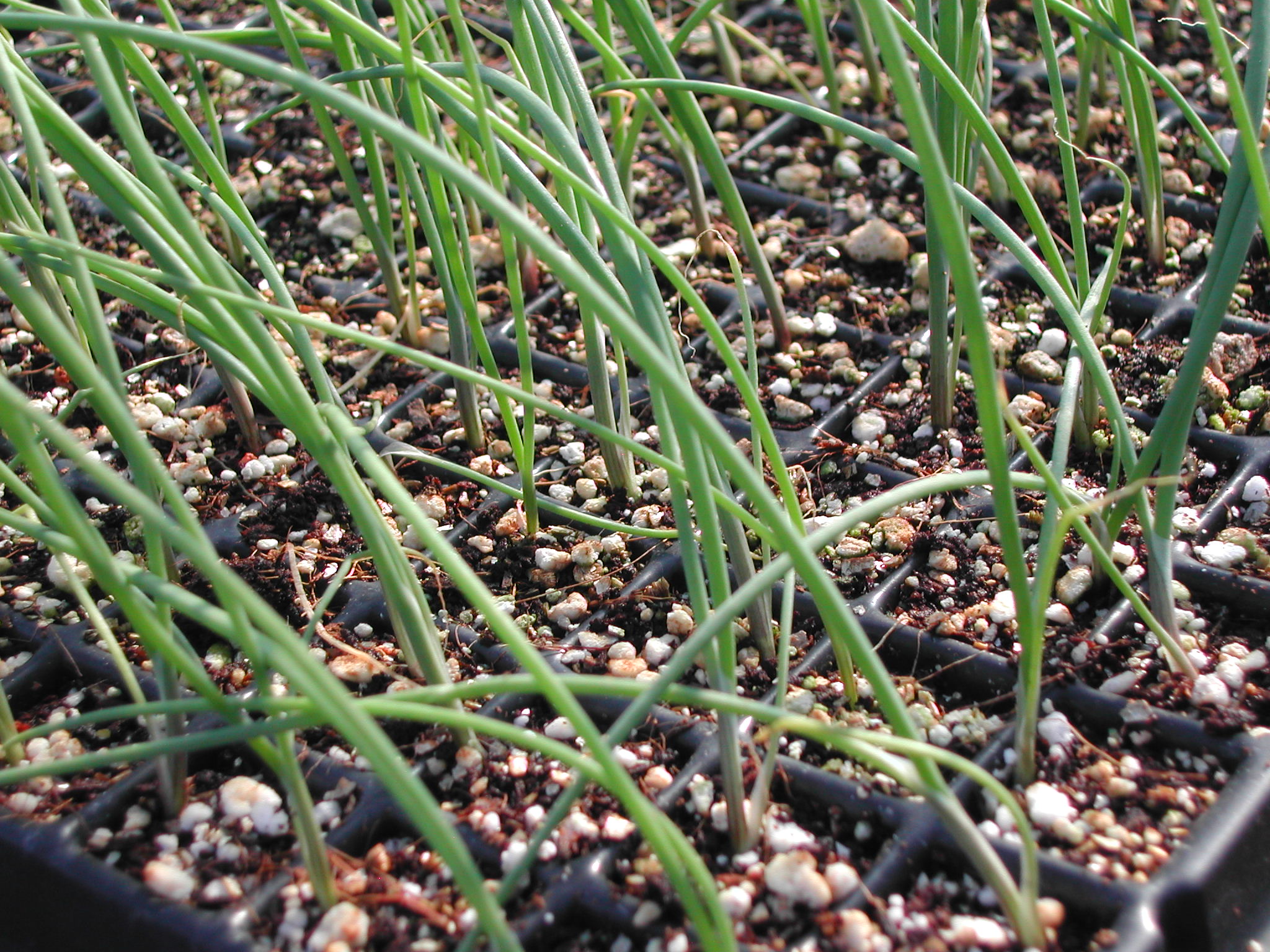
Onion starts
It is raining today, it has been quite a bit this week, giving me a good chance to work here, inside. I made a few changes to the blog, a new “theme,” a few new pages, and finally, another post.

Carrots in hoop house
On February 2, I started planting seeds. First, it was carrots in the hoop house (an experiment to see how early I can get the first round of carrots). Then, onions, broccoli, kale, leeks, chard, fennel, cabbage, peas, lettuce, assorted chicories and greens, and a few herbs, all started inside, in the basement, under lights. (Sigh, I’m still dreaming of a greenhouse for starting all my seeds.) The first round of peas were planted in the other hoop house, the second and third outside. Beets are in the ground, though not up yet. The warmer weather and long season crops are getting started: tomatoes, peppers, eggplant, celery and celeriac (also under lights in the basement).
I have a new tool to help keep me on track with seed starting and planting: a massive spreadsheet from a workshop I took in January, Crop Planning for Diverse Plantings. The half-day class focused on the use of a very detailed spreadsheet for planning a season of crops. It was created by the instructor for use at one of the larger CSA farms in the area, but is useful even for tiny little gardens, like mine. I am trying it out, using the relevant parts, and hoping to keep myself on track, especially for successive plantings of things like lettuce. So far, so good. I just started the third planting of lettuce yesterday.

Cabbage starts
I found some other interesting classes to take after Crop Planning. The Oregon State University Extension Small Farms Program put together a Growing Farms series, for beginning farmers. Over six sessions, they gave on overview of what you need to know to farm in Oregon. I loved it! Topics ranged from the inspirational “How I got into farming,” to land use, water rights, labor, food safety, marketing, finance, soil and pest management, and insurance. Hard to cover all those topics in six sessions, even if they were five hours each. Several local farmers came to speak; they were some really amazing people. We were like groupies for these rock-star farmers. Yes, that was “we.” I even talked Steven into going with me, so he would hear all the same information and we could look at this market garden/farming venture from the same vantage point. It started some dreaming on our part: what if we could find ten or twenty acres? Could we farm as our main source of income? (No other income? Some of the farmers told us how much they earned in a year…) Certainly something we are thinking about.
I started another class last Wednesday, called Hands-On Organic Farming out at Gales Meadow Farm near Forest Grove. For the five sessions of this class, I am hoping to get some very practical how-to information to scale up my production and work more like a farmer than a gardener. Tomorrow I head out to the Kennedy School to take a City of Portland Urban Growth Bounty class on beekeeping. I have been thinking about keeping bees for sometime. This class should help me decide whether or not to pursue it. Hmmm…maybe someday June’s Corner Garden honey.

Asian pear blossoms and a bee!
Happy New Season!
We are almost two weeks into the new year and the new gardening season is coming! I hope you all enjoyed the fall/winter holidays and are excited for the possibilities of this new year.
Even though we are well past Thanksgiving, I just wanted to show you a few pictures from our meal. My family came out for a few days and some of Steven’s family joined us for Thanksgiving dinner. My goal for the meal was to have as much as possible come from our garden or very close by and I think we did pretty well. Here are some pictures from our dinner…
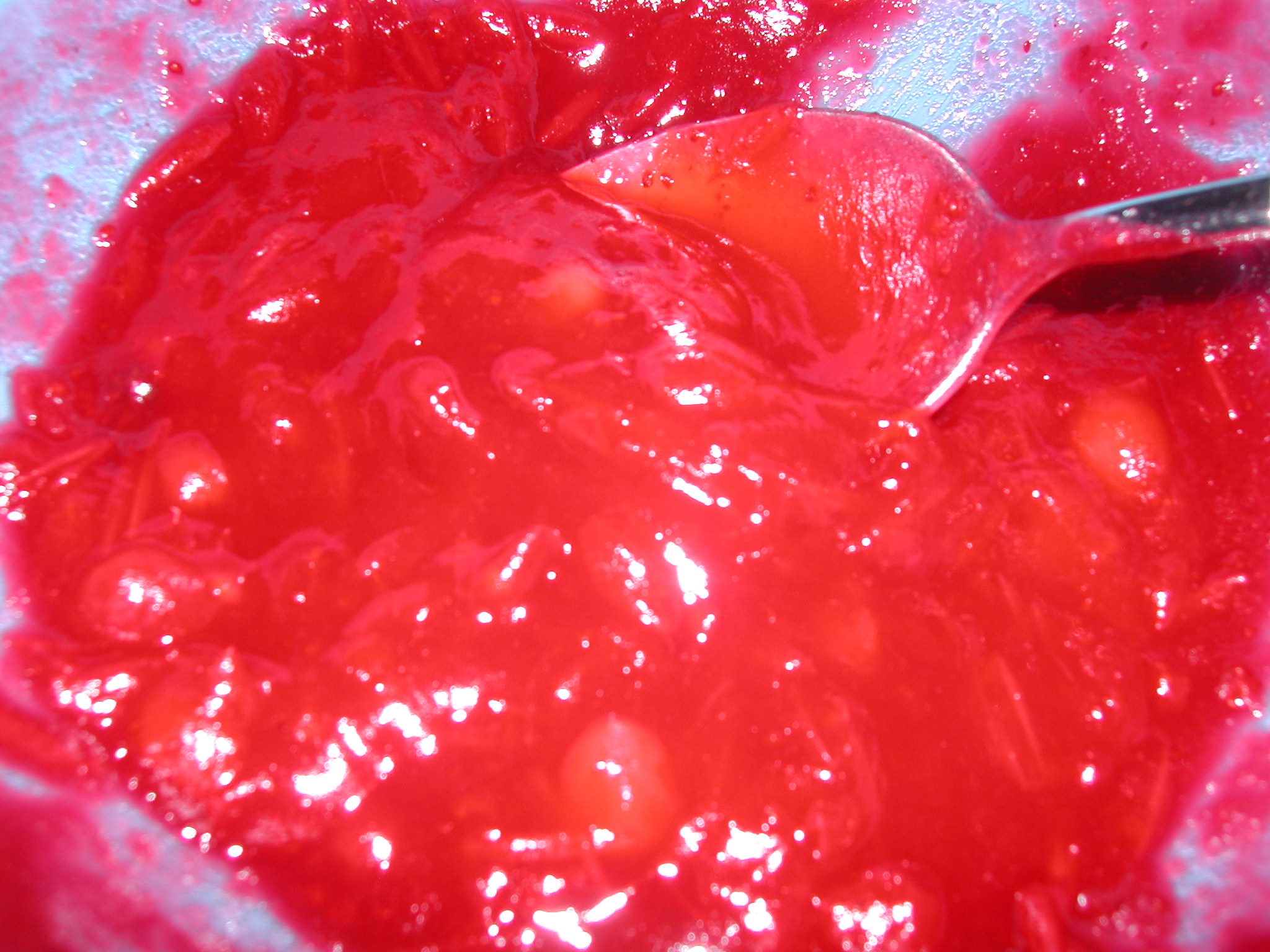
Yes! The cranberry sauce from our cranberries! Hopefully there will be more next year.

Roasted potatoes, carrots and beets, with olive oil (not ours yet)

Green beans with garlic and hazelnuts (hazelnuts from Freddy Guys Hazelnuts in Monmouth)
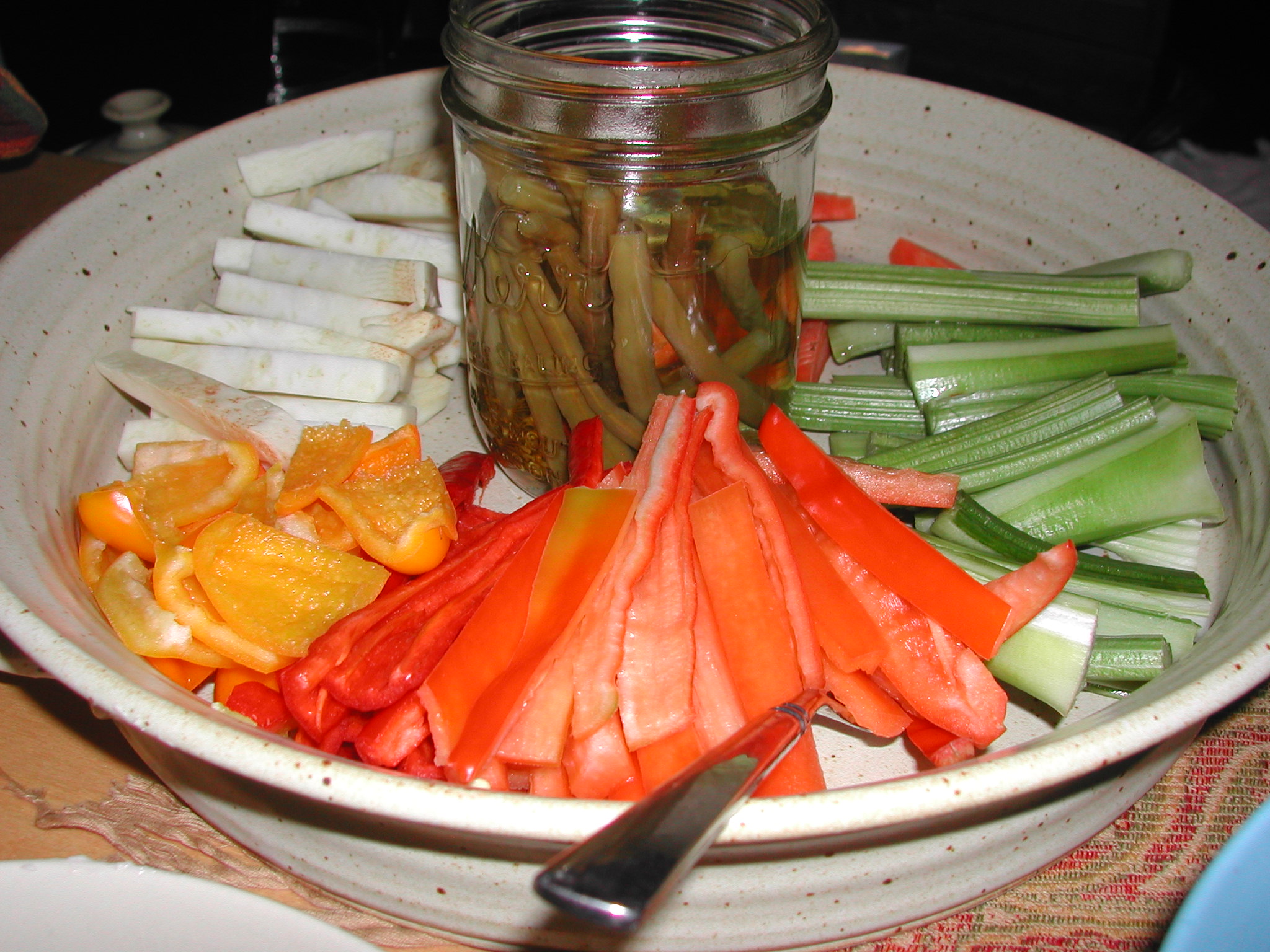
Dilly beans, sweet peppers, celery, carrots and celeriac

Corn, garlic, sweet peppers and basil (corn from Kruger's Farm Market on Sauvie Island)

Turkey (legs) raised on Sauvie Island by Dan from Linnton Feed and Seed

What's left of the pork loin roast from Brown Dog Acres on Sauvie Island
I didn’t make dessert until Christmas, when I made a pumpkin cheesecake. I used the recipe from America’s Test Kitchen, using the biggest Sweet Meat Hubbard squash I had (over 18 lbs). I roasted half in the oven and chopped up the other half to freeze.
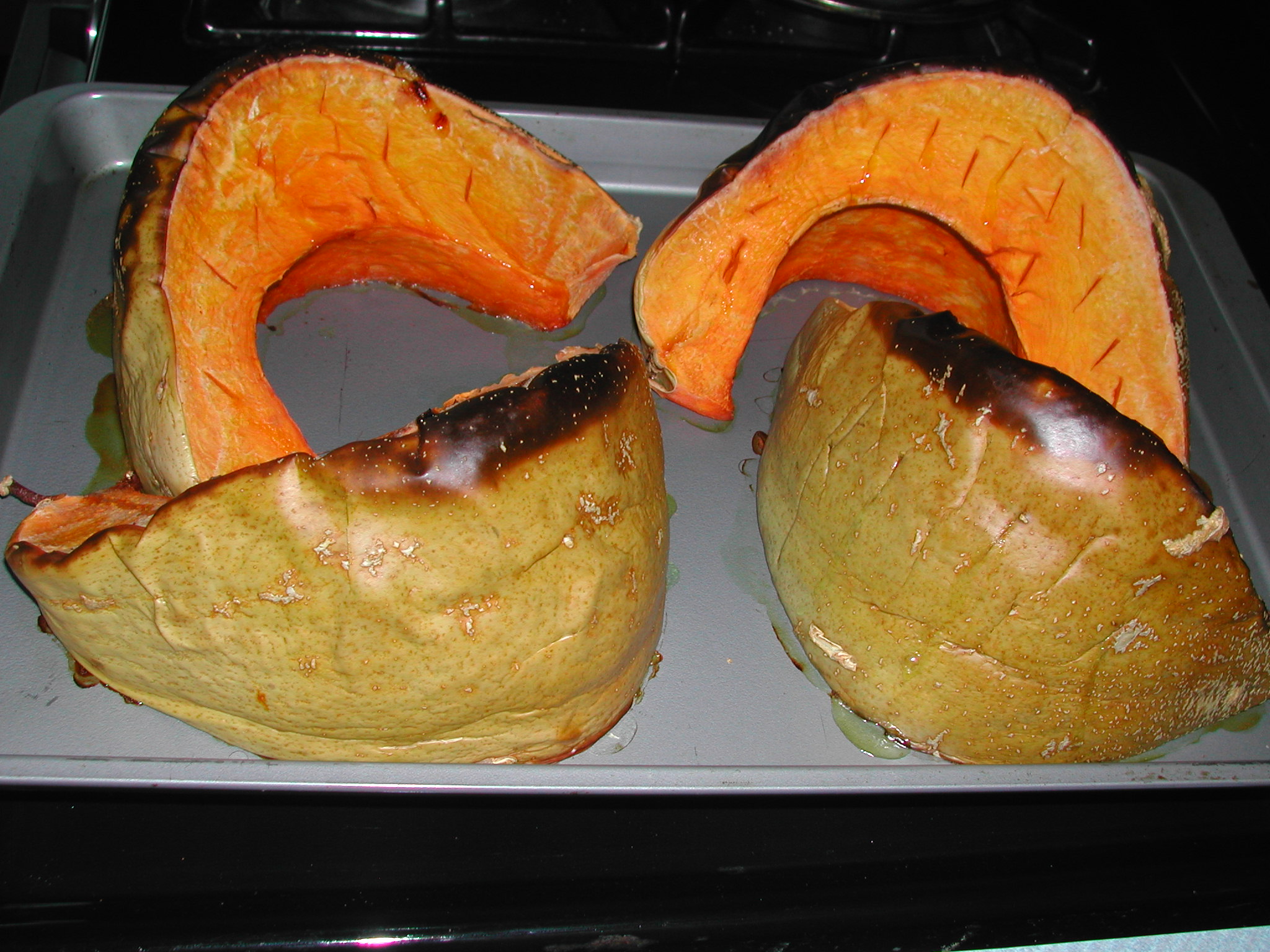
The roasted hubbard squash

The puree from the roasted squash
I pureed the roasted half for the cheesecake and still had plenty left over for a curried squash soup and more to freeze. I still have three more hubbard squash in the garage. I am glad they store for a long time!

The pumkin cheesecake is ready!
And now for the new year and the new season. I am very excited about getting to work planning, building and strengthening the health of the garden and the orchard.
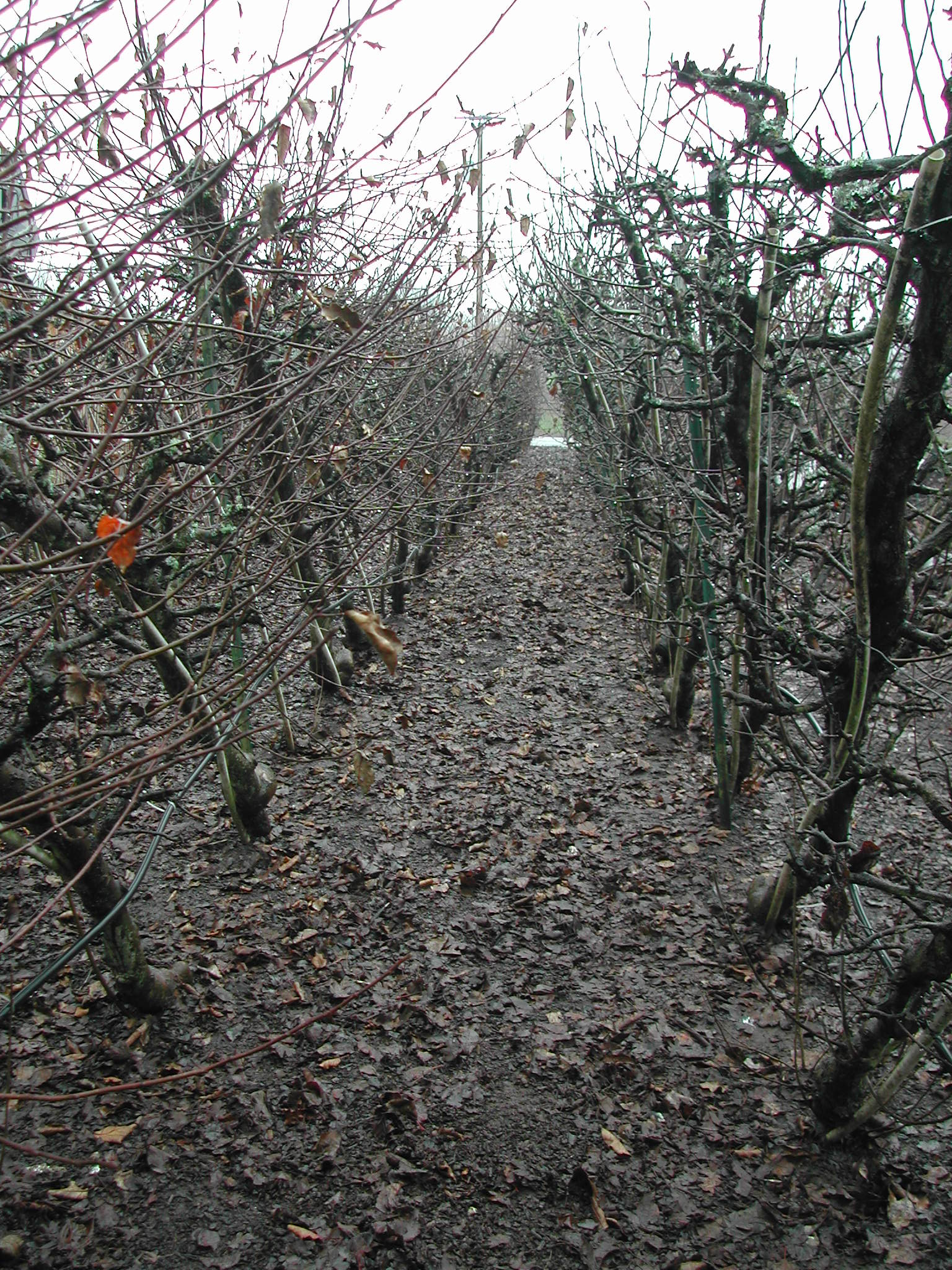
Out in the orchard today

The Appple Grower...an amazing book
Last week I started my research and reading for the apple orchard, with The Apple Grower by Michael Phillips. Everytime I read about holistic approaches to growing I get energized. It all makes so much sense, I can’t imagine gardening in any other way. As for the refurbishing of the orchard, it could take a lot longer than I was expecting to gather all the information that I want. But hopefully, I’ll get a start on the work that needs to be done.
Putting My Feet Up
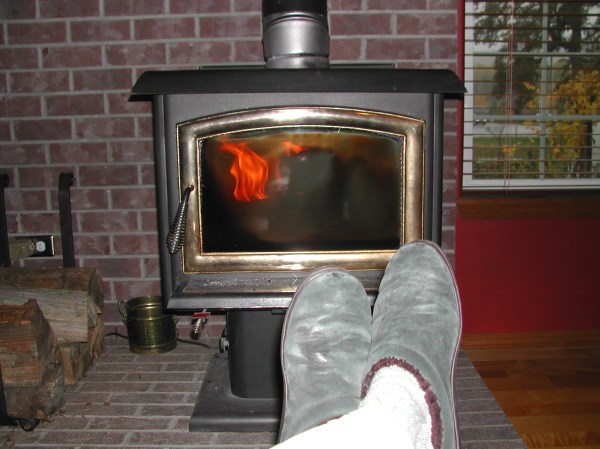
I'll spend some time here this winter.
At least a little, on rainy and really cold days. Winter is coming and the last delivery for the 2009 season of June’s Corner Garden is this Thursday. It has been a very good season and though I don’t like to see it end, I am ready to slow down into a winter pace. People sometimes ask me what I do in the off-season. The work doesn’t ever quite stop, but it shifts to more inside work than outside work (at least for December and January).
Here are a few of the things I’ll be working on this winter:
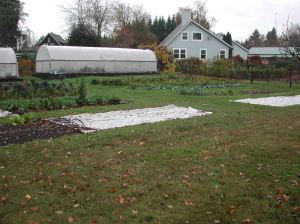
A few beds are ready for winter, still more to go.
1. Finish cleaning up the garden and getting it ready for winter. I hope to have all the beds cleared and either planted with cover crop or covered by a leaf mulch by the end of November. I still have some plants (lettuce, kale, endive and escarole) in one bed and will keep growing in the hoop houses (lettuce, kale, leeks, mustards, arugula, bok choi, other greens), partly to feed us and partly to experiment with how much will actually grow during the winter.
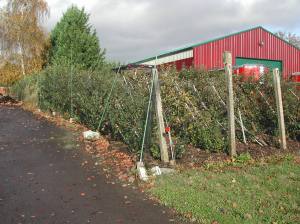
I am looking forward to refurbishing the orchard.
2. Take care of the orchard. This is my big project for the winter. The support system is old and needs to be replaced, so we thought this would be a good time to make changes to the orchard. I will be researching systems for espaliered trees and will try to find an “expert” to help us create the best design/layout for the orchard. We also want to put a permanent fence around the orchard, since the chickens spend quite a bit of time there. I’ll continue to research (and take requests!) for different varieties of apples, especially heirloom varieties, to replace trees as needed.
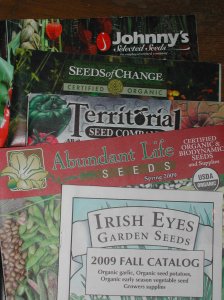
I am waiting for the 2010 catalogs to arrive.
3. Dream, plan, order, clean and organize seeds and seed starting equipment. First I’ll clean and organize all the pots, trays and seeds used this past season, ready to be used again in February. Then, I’ll start the dreaming, planing and ordering seeds. (I really do this all year, but will get it on paper in January.) I am thinking about melons next year. If you have eaten some good varieties from local growers, I would love to hear about them.
4. Read and learn. My Autumn Food Growing class will continue until December 9. I’ll look for other classes, workshops or conferences to attend. I have a huge stack of books that I want to read. I don’t know how much I will get through, but will read as much as I can (in print and online).
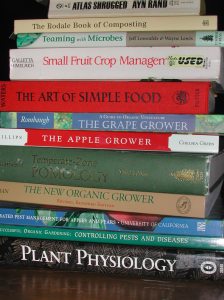
These are some of the books that will be sitting by my chair by the fire.
5. Work on the June’s Corner Garden blog. I am hoping to add pages, to make it more of a website, as opposed to just a blog. My main idea is to add pictures, information and recipes for the different fruits and vegetables I grow.
6. Finish up the bookwork and record keeping. Since the business is small, the books don’t take too long to complete. Studying the records from the garden and sales will help in planning for next year.
7. Back outside. In February, I start more work outside again, beginning with pruning the trees, grapes and berries. Inside, I’ll be starting seeds.
Barbie can have the chair again in March.
I plan to post a few times to the blog this winter and I will send an occasional e-mail update. I am thankful every day to have a job I love and such great customers. Thanks for making 2009 a wonderful season!
Bed Time

The tomatoes are waiting to be put to bed
The harvest is pretty much over, just a few more apples to pick today and some grapes tomorrow. I have a few crops I’ll leave in the garden and in the hoop house to eat over the winter, but otherwise, the garden is ready to be put to bed.
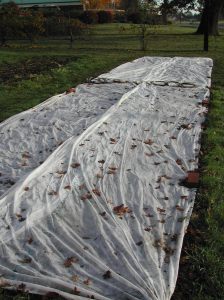
This bed is planted with cover crop
With Steven’s help, I started clearing out a few beds a week ago. We worked on a few more this past weekend. I got some cover crop planted (fava beans and vetch). I am still experimenting with different cover crops, to see which works the best for us. I put the white row cover over it for a little extra warmth to help the seed germinate. And after a week, it is starting to grow.

A fava bean germinating under the row cover
There is a lot more bed clearing to do, but in yesterday’s beautiful weather, it was time to plant garlic. I planted four varieties: Chesnok Red, Spanish Roja, Inchelium Red and Early Italian Purple.

The garlic is planted here
It is funny how a simple tool can make a task so much easier. I saw in a seed catalog some plastic tubes to put over the tines of a landscape rake, so it could be used to mark rows. It was a very simple, inexpensive idea that worked great.

Plastic tubes over the tines of a landscape rake...a simple tool to mark rows
I put tubes on our landscape rake and marked rows 4 inches apart. It was much easier to place the garlic.
My last task for the garlic is to put a layer of compost over the top. But first, I have to find the compost that is hidden under the leaves in our compost bins.

There is compost hidden somewhere under those leaves
Cranberry Harvest

Can you find the cranberries hidden in this picture?
It is kind of like the Highlights magazine you looked at in the dentist’s office when you were a kid. Remember the puzzle page, the one were you find objects hidden in a picture? Yep, can you find the cranberries hidden in the picture above? (Hint: Look in the bottom left quadrant.)
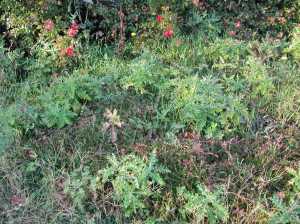
Kind of reminds you of the picture I put up during the summer, huh?
It really wasn’t that bad. I started picking cranberries on Saturday. I’m sure there are faster ways to do it, but I just dug around in the cranberry vines to find the berries. I didn’t get too far, just one little section, because the cranberries need to be weeded, too, and I only had a little time left before it got dark. You might remember I posted about cranberries before, and how bad the weeds were. That was the last time I weeded that bed and it has been waiting for another cleaning out. Maybe someday the cranberries will be thick enough to keep the weeds out, but I think there are a lot of weed seeds just waiting to sprout.
I am pretty excited, though, to actually have my first cranberry harvest. I am not sure how many I will get altogether, certainly enough for cranberry sauce this Thanksgiving, and maybe more to freeze or try to make some juice. It gives me hope that there could be cranberries in the future of June’s Corner Garden.
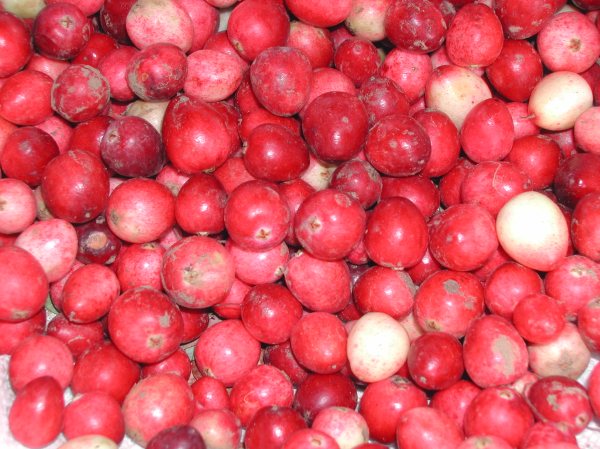
Part 1 of the cranberry harvest
A New Class
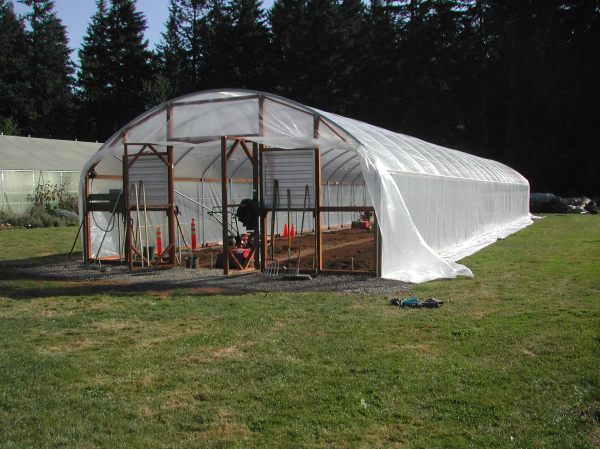
This is the hoop house for the Autumn Food Growing class
I sometimes wonder how things would be different if I had studied agriculture in college in some form. I have no plans to go back to school full time, but I have so much that I want to learn, that I am always on the look out for an interesting class or workshop.
Last year, I took a five week class on fruit trees and workshops on irrigation, soil building and fruit tree grafting. A few weeks ago, I started a class called Autumn Food Growing at Clackamas Community College, an “11 week class [that] utilizes a hands-on approach to organic methods of growing cool season food plants, using a hoop-house, through the study of soil ecosystems, variety selection, pest management, data collection, harvest, and storage.” I hope to learn how to use our hoop houses to their maximum potential.
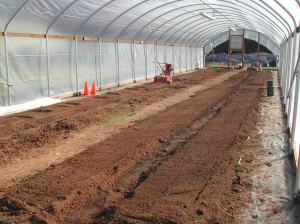
Preparing eight beds inside the hoop house
The hoop house we are working with is big: about 20′ wide by 96′ long. Four of our hoop houses could easily fit inside. At the first class, we put the plastic up over the frame. Somehow, even though I don’t enjoy being on the high end of a ladder, that is precisely where I climbed: to the top of an orchard ladder, ready to pull the plastic up over the top of the structure. Three or four of us were spread out over the 96 foot length. I happened to be in the middle, the only one positioned under the peak of the frame. The other three got the plastic up to a point where I could grab a handful. Then they let go, getting down to reposition their ladders, so we all could pull the plastic over the top. As they climbed down, that left me holding the plastic up when a gust of wind hit. I tried to hold on, to both the plastic and the hoop house. I tried not get pulled off by the big plastic parachute, but it was no good. With the instructor yelling, “Hold on!” the plastic slipped out of my hand. Ten minutes, a better grip on the plastic, and no wind gusts later, we got the plastic over the hoop house.
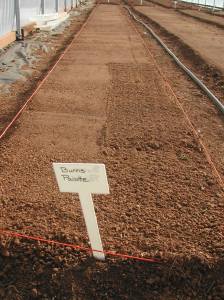
The bed I will be working on
Since then, we have been preparing the beds for planting, which could happen this week.
First Frost
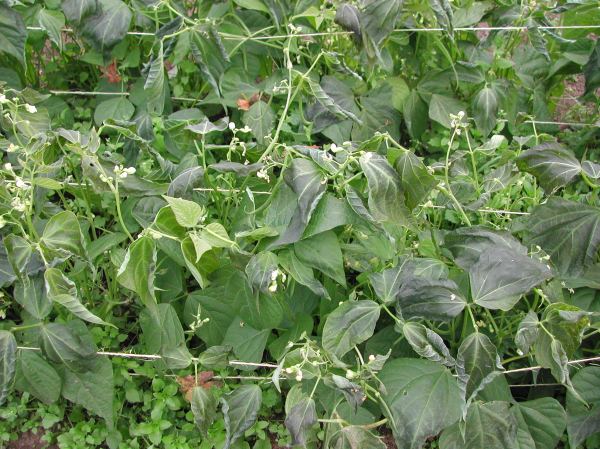
Damaged bean plants
Kind of. I guess it could count as the official first frost. Saturday night we had a light frost. It was very light, nothing completely died, but it did some damage. I had a late planting of beans that needed a long warm fall to bear. I just picked the first few beans from those plants last week, but they have been hurt. Will they produce any more beans? I am not sure.
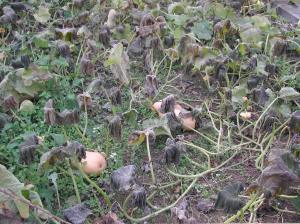
Dying butternut squash vines
Other warm weather plants were hurt, too: eggplant, peppers, winter squash, zucchini (though the latter two were dying back anyway).
Then the weather reports said it would be even colder Sunday night. So, I went out and picked tomatoes (green and red), sweet peppers and the last eggplant or two. I cut down whole hot pepper plants. Monday morning I woke up to 40 degrees. Sigh.
We put up the end plastic on the second hoop house on Saturday. I still have peppers in the hoop house that are doing great (sweet and hot) and a few tomato plants, among other things.
But for now, green tomatoes, anyone?

Here they are.
Slowing Down

A typical foggy fall morning
The garden is slowing down. I was a bit worried Sunday night, when Steven said there was a frost warning on the weather report. It was already dark, too late to go out and pick everything that would die with a frost. Luckily, it didn’t frost here and it even stayed above 40 degrees Sunday night. I’m not quite ready for the end of the summer vegetables, but that first frost is getting closer. So far this morning the low temperature is 38 degrees and it could still get a little colder before it warms up.

The eggplant are still trying to produce.
So, yes, a few things will be missing from the weekly list of vegetables. The basil is done now. It hasn’t died, but it has lots of brown, dead spots on it. The yellow butterstick and patty pan squash are done. I pretty much picked the last of the eggplant last week. It really won’t have time to form any more fruit, though there are still some blossoms. Other summer vegetables may be on the list one or two more times before they are gone for good, things like tomatoes, zucchini and beans. I have a few summer vegetables (cucumbers and peppers) in the hoop houses, so they should last a little longer.

The end plastic is going back up on the hoop houses.
Speaking of the hoop houses, Steven and I put up the end plastic on one of the hoop houses on Sunday. We had to do some repairs, so we only got one closed up. I really am hoping for a no frost week, until we get the other hoop house closed up. Hopefully, that will get done next Saturday.
Here are pictures of our molting Dominique chicken. She is doing well. Her feathers are growing back in nicely. They kind of looked like little paintbrushes at one point. Hopefully, her feathers will be completely in before it gets too cold.

Not a great picture, but you can see the bare patch on her back and the new feathers poking out.
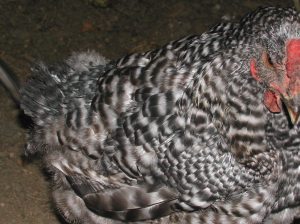
Small new feathers are covering the bare patches now.


